
Abstract
Quantum physics, also known as quantum mechanics, is the branch of physics that examines matter and energy at atomic and subatomic scales. Emerging in the early twentieth century, it fundamentally transformed scientific understanding by introducing probabilistic interpretations of physical phenomena. This paper explores the historical development, foundational principles, mathematical structure, and technological applications of quantum mechanics. Key concepts such as quantization, wave–particle duality, superposition, the uncertainty principle, and entanglement are examined within both theoretical and practical contexts. The study concludes by discussing the continuing relevance of quantum physics in modern research and emerging technologies.
Introduction
Classical physics successfully explains motion, gravity, and macroscopic systems; however, it fails to accurately describe phenomena occurring at atomic and subatomic levels. Quantum physics addresses these limitations by providing a theoretical framework that accounts for the discrete and probabilistic nature of microscopic systems. Today, quantum mechanics underpins chemistry, materials science, condensed matter physics, and modern electronics.
Historical Background
The origins of quantum theory can be traced to experimental inconsistencies observed in the late nineteenth century. In 1900, Max Planck proposed that energy is emitted in discrete packets, or quanta, while studying blackbody radiation. Shortly afterward, Albert Einstein (1905) explained the photoelectric effect by suggesting that light behaves as quantized particles called photons.
Further developments included Niels Bohr’s atomic model, which introduced quantized electron orbits, and the mathematical formulations of Erwin Schrödinger and Werner Heisenberg, whose independent approaches laid the formal foundation of quantum mechanics.
These breakthroughs collectively replaced deterministic classical descriptions with a probabilistic theoretical structure.
Fundamental Principles of Quantum Physics
Quantization of Energy
Quantum mechanics asserts that energy is not continuous but exists in discrete amounts. Electrons in atoms occupy specific energy levels and can transition between them by absorbing or emitting fixed energy quanta. This explains atomic emission and absorption spectra.
Wave–Particle Duality
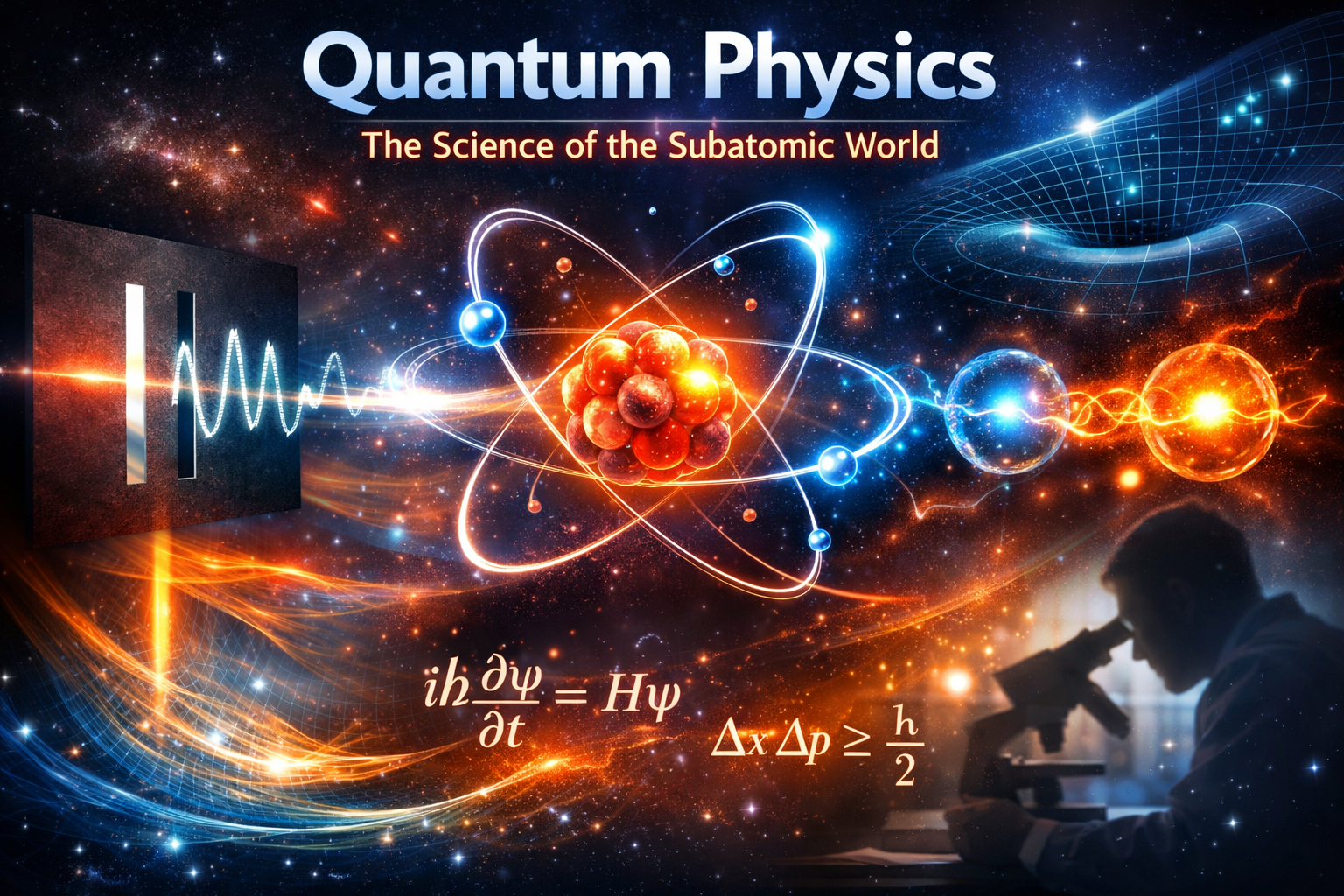
Experimental evidence demonstrates that light and matter exhibit both wave-like and particle-like properties. The Double-slit experiment provides compelling confirmation of this duality, showing interference patterns even when particles pass individually through slits. This suggests that quantum entities cannot be categorized strictly as particles or waves but display characteristics of both depending on measurement conditions.
Superposition
Superposition describes the ability of quantum systems to exist simultaneously in multiple possible states until measurement occurs. A quantum particle’s state is described by a mathematical function representing probabilities rather than definite outcomes. This principle forms the theoretical basis for quantum computing.
Uncertainty Principle
The Uncertainty principle establishes that certain physical properties, such as position and momentum, cannot be simultaneously measured with arbitrary precision. This limitation is intrinsic to nature and reflects the probabilistic structure of quantum systems.
Quantum Entanglement
Entanglement occurs when two or more particles become correlated in such a way that measuring one immediately influences the state of the other, regardless of spatial separation. This phenomenon challenges classical intuitions about locality and causality and has been experimentally validated.
Mathematical Framework
Quantum mechanics relies heavily on mathematical formalism. The state of a system is represented by a wave function (ψ), which evolves according to the Schrödinger equation. Rather than predicting exact values, the wave function provides probability distributions for measurable quantities.
The probabilistic interpretation of quantum mechanics, introduced through the Born rule, distinguishes it fundamentally from classical deterministic mechanics.
Measurement and Interpretation
Measurement plays a central role in quantum theory. When a system is observed, the wave function appears to collapse into a definite state. Contemporary interpretations emphasize decoherence, in which interaction with the environment produces definite outcomes without invoking conscious observation.
Despite significant progress, debates continue regarding the philosophical implications of quantum measurement and the nature of reality.
Applications of Quantum Physics
Quantum mechanics has transformed modern society through numerous technological advancements:
- Semiconductors and Transistors – Foundation of digital electronics.
- Lasers – Applications in medicine, communication, and industry.
- Magnetic Resonance Imaging (MRI) – Based on nuclear spin principles.
- Quantum Computing – Utilizes superposition and entanglement for enhanced computational power.
- Quantum Cryptography – Enables secure communication based on quantum key distribution.
Without quantum theory, contemporary computing, telecommunications, and advanced medical imaging would not exist.
Future Directions
Current research aims to unify quantum mechanics with general relativity through a theory of quantum gravity. Investigations in string theory, loop quantum gravity, and quantum field theory continue to expand the frontiers of knowledge.
Emerging quantum technologies promise transformative impacts on cybersecurity, artificial intelligence, materials science, and energy systems.
At the end Quantum physics represents one of the most significant intellectual revolutions in scientific history. By introducing quantization, probabilistic interpretation, and fundamentally new principles governing matter and energy, it reshaped modern science. Beyond its theoretical elegance, quantum mechanics underlies the technological infrastructure of contemporary society and continues to guide groundbreaking research.
References
Bohr, N. (1913). On the constitution of atoms and molecules. Philosophical Magazine, 26(151), 1–25.
Einstein, A. (1905). On a heuristic viewpoint concerning the production and transformation of light. Annalen der Physik, 17, 132–148.
Heisenberg, W. (1927). On the perceptual content of quantum theoretical kinematics and mechanics. Zeitschrift für Physik, 43, 172–198.
Planck, M. (1901). On the law of distribution of energy in the normal spectrum. Annalen der Physik, 4, 553–563.
Schrödinger, E. (1926). Quantization as an eigenvalue problem. Annalen der Physik, 79, 361–376.